writing essay
The Space Between
On thresholds, pictures that are neither photographs nor paintings, and the patience of static.
4 min readseed 412
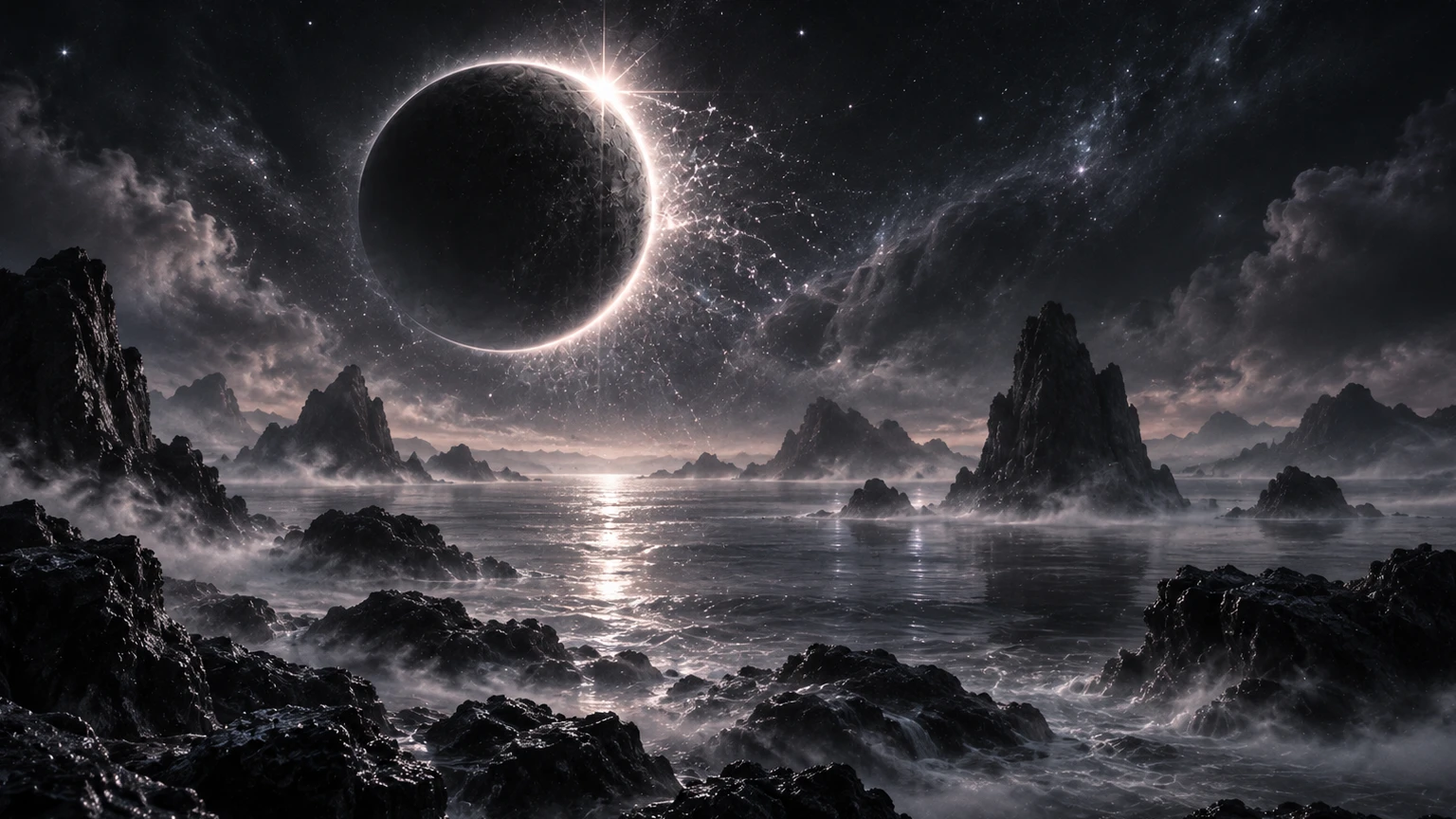
Hero image prompt: a total eclipse over a black sea, corona, mist on the water, dark rock, stars, somewhere between synthetic and real
Every image I make begins as static: a field of random noise the size of the finished picture, grey and grainy, like a television tuned between channels. The model's whole job is to take some of that noise away, a little at a time, until something is left.
The usual count is thirty steps. At each one the model looks at the static, guesses which part of it is noise, and removes some of what it guessed. It doesn't draw, exactly. It never sees the picture it's making, only the next, slightly less noisy version of it. Somewhere around step eight a horizon shows up. By twelve there's a figure, or a moon, or a shape that would like to be one. The last ten steps are mostly eyelashes.
I've been thinking about that middle stretch for a while. The Latin for threshold is limen, and it gives us liminal: the state of standing on the line between one room and the next. Dusk is liminal. So is the hour after a hard phone call, and a hotel corridor at three in the morning. They're places you pass through rather than arrive at, and they feel strange because nothing in them has finished deciding what it is.
The pictures that come out the other end live there too. They aren't photographs. No light from that shoreline ever reached a sensor, because there was no shoreline. They aren't paintings either. Nobody moved a brush, and the hand that usually leaves its record in the paint isn't there to find. People keep trying to file them under one or the other, and they keep sliding off the shelf.
I don't think that makes them lesser, and I don't think it makes them magic. It makes them a third thing, which is harder to talk about. A photograph is a record of something that was there. A painting is a record of someone's attention. A generated image is closer to the record of a conversation between a sentence I wrote, a seed number, and a model that learned what pictures look like from a great many pictures other people made.
That last part should be said plainly rather than tucked into a footnote. The model knows what a coastline looks like because people photographed and painted coastlines for a very long time. Whatever I make with it stands on their work, and I'd rather say so than pretend the static came from nowhere. It didn't. It came from all of us, averaged into fog.
The practical thing the noise teaches is patience, which I didn't expect to learn from software. For the first few steps every image looks the same: a bruise of colour, a soft dark mass, a lighter patch where the sky might go. You can't tell a good image from a bad one at step four. I know because I've cancelled a lot of renders at step four, then run the same seed again later and found out I'd thrown away the one I wanted.
So now I let them finish. Most of them aren't good. But the judgement has to wait until there's something to judge, and the waiting turns out to be part of the work rather than a gap in it. I suspect this is true of most making. The first draft of anything is static with a horizon in it. The idea is there, roughly, the way the figure is there at step twelve: implied, a little smeared, waiting for the steps that will either sharpen it or show that it was never really there.
There's a version of this work that's all speed: a hundred images an hour, keep one, scroll past the rest. I've done that, and the pictures from those nights all look alike to me now. The ones I still like came from slower evenings, changing one word at a time and watching what it did, letting a seed run to the end even when the middle looked wrong.
This page is built the same way. The picture at the top started as noise when you arrived, and each paragraph you've read has taken a step out of it. The counter in the corner is keeping score. If you skipped to the end, it sharpened all at once, which is also roughly what skipping to the end of anything feels like.
I like that an image is never really finished, only stopped. Thirty steps is a habit, not a law. Run the same seed for forty and it shifts a little; give it a second pass and it finds detail it didn't have before. Where to stop is a choice, and of everything in the process it's the part that's most clearly mine. Most days I stop a little earlier than I could, while the picture still has some of the threshold in it and looks like it might have gone another way. That's usually the one I keep.