writing essay
Synthetic Dreams
Generated images and dreams build their scenes the same way, and come apart in the same places.
3 min readseed 2207
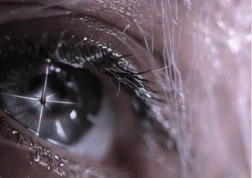
Hero image prompt: extreme close-up of an eye, wet lashes, a star of light caught in the iris, stray hair, soft grey light, half awake
Generated images and dreams have a lot in common, and the clearest resemblance is in how they fail. Both are good at the feeling of a place and vague about its particulars. Both go wrong, reliably, at the hands and at the writing.
Hands first. A model doesn't count fingers. It learned what hands look like from the way hands turn up in pictures generally: holding cups or half hidden in pockets, often cut off by the edge of the frame. What it knows is roughly what hand-ish things look like next to other hand-ish things, and at each step it makes every small region a little more plausible. Five fingers is a fact about the whole hand. The model works in neighbourhoods, and a sixth finger looks perfectly reasonable standing next to the fifth.
Text is the same problem in a different shape. Lettering is everywhere in pictures, on signs and book spines, and older models learned what lettering looks like rather than what it says. Newer ones spell much better, but the old habit comes back whenever the words get small. You get signs written in something that is almost a language: the confident shapes of words with nothing inside them.
Dreams do this too. Among the tests people use to notice they're dreaming, two of the most common are these: look at your hands, and read a line of text, look away, then read it again. In a dream the fingers drift in number and the words rearrange themselves between one glance and the next. The two places a dream gives itself away are the same two places a model does.
I don't know enough about sleep to say the resemblance goes deep. A brain isn't a diffusion model, and anyone who studies dreaming would be right to wince at the comparison. But the shape of the failure is suggestive. Both seem to build a scene from what usually goes together, without anyone checking the sums. A hand is a thing that usually has fingers around here. A sign is a thing that usually has letters on it. Close enough, says the dream, and moves on.
The eye at the top of this page has a star in it. Look at the iris and there's a small four-pointed glint, the kind a camera lens makes when it catches a bright light. Real eyes don't do that on their own. A real eye reflects the shape of whatever is lighting it, a window or a lamp. The model put a star there because close-up photographs of eyes so often have one, and it learned that eyes come with stars. It remembered the photographs, not the eye.
That's a dream detail too. Dreams are full of things that come from pictures of things rather than the things themselves: a house lit like a film set, a stranger whose face is mostly a mood.
Spending a lot of time with generated images changes how I look at ordinary ones. I check the hands in photographs now, not because I doubt them but because they're so specific: a knuckle that bends a little wrong, a ring that has worn its own groove. A shop sign that spells its own name correctly has started to look like a small achievement. The real world is full of details nobody would have predicted, and those are exactly the details a model is worst at.
It goes the other way as well. Some nights my dreams arrive with the same smooth finish as the renders, rooms lit from nowhere, a corridor that carries on a little past where it should. Once I looked at a hand in a dream and thought, quite calmly, that it needed another pass.
What I take from all this has to do with averages. A model and a dream both produce what usually happens, and what usually happens is lovely and slightly empty, like a room that has been tidied by someone who never lived in it. The particular things are what make a picture belong to somewhere. A scar. A misprint on a menu.
None of it makes me trust my eyes less. If anything it's the reverse. A dream can't keep a sentence still, and neither can the model. The world can, and does, all day, without being asked. Every so often I read a real sign twice, just to watch it stay the same.